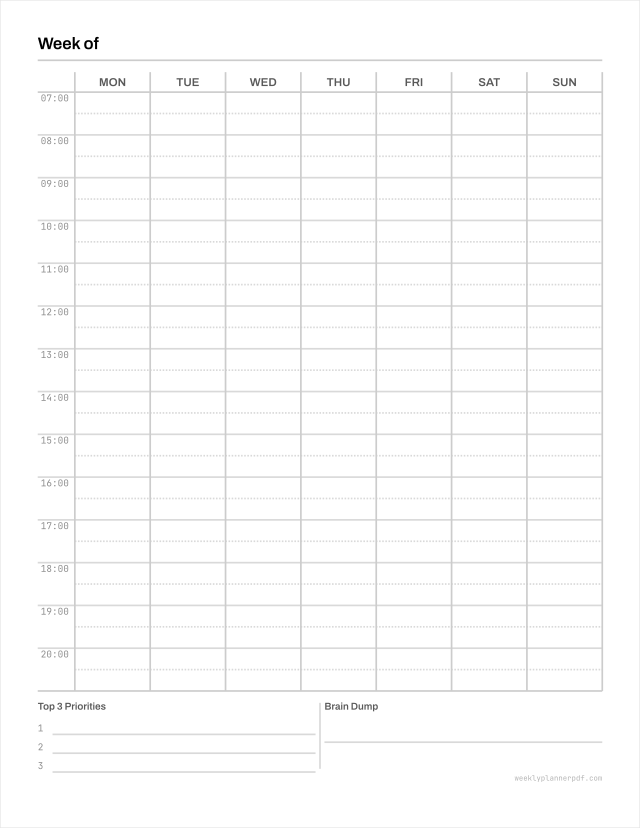
ADHD weekly planner
A weekly sheet built around the two things that break most planners for people with ADHD: time being invisible, and a list long enough to make starting feel impossible.
No signup. No email. No watermark. No limits.
- Page box
- 215.9 x 279.4 mm 612 x 792 pt
- Margins
- 12.7 mm all sides
- Writing rows
- 7.5 mm
- Hours
- 07:00 to 21:00, 30 min rows
- Colour
- DeviceGray, rules at 20% K
- Scaling
- Prints at 100%, Actual size preset
Other versions: Sunday start, 2-up and trim-mark sheets
Why an hour grid rather than a list
Time blindness, the difficulty of feeling how long something will take or how much of the day is left, is one of the most consistently reported experiences in adult ADHD. A to-do list makes that worse, because a list has no length. Twelve items look the same on paper whether they add up to two hours or twenty.
An hour grid gives the day a physical size. When you write a task into a slot you are committing to a duration, and when the slots run out the day is full. That is a mechanical fix rather than a motivational one, which is the kind that tends to survive.
Three priorities, not a list
The default sheet has room for exactly three priorities. That is not a space constraint, it is the point. Every planning system that has been through real testing converges on a small fixed number: Full Focus calls it the Weekly Big 3, Panda uses top three to five, Passion Planner uses a single weekly focus.
A list of fifteen creates a decision before you have started, and deciding what to do first is often the expensive part. Three does not.
The brain dump is doing real work
The panel at the bottom is for everything that is not going in the grid: the thing you remembered mid-task, the thing you are worried you will forget, the thing that does not belong to this week at all. Getting it out of working memory and onto paper is the point, and it is why the panel is unruled and unlabelled.
It is deliberately at the bottom of the sheet rather than the top, so it does not become the first thing you fill in.
Print it, do not save it
A planner you have to open an app to see is a planner you will not see. Print this and put it somewhere you physically pass. A weekly sheet on a wall or a desk works because it does not require you to remember to check it.
One sheet a week, printed on Sunday, is also a lower commitment than a bound planner that guilts you with blank pages when a week goes badly.
Also known as
This layout is searched for under several names, and they all describe the same file: adhd planner printable free pdf, adhd daily planner for adults printable, printable planner for adhd adults. One page, one grid.
Questions
Should I use hourly or a simpler layout?
Start hourly. If you find yourself not filling the slots, move to the horizontal layout, which gives you four writing lines a day without asking for times. Both are free and take a minute to try.
Is there a daily version?
The generator can produce a single-day hourly sheet by setting the day count to one. Some people find a week too much surface area and a day is easier to face.
Related
- Weekly to do list
If the grid feels like too much structure
- Weekly habit tracker
For the things that need repeating rather than scheduling
- Time blocking guide
The method behind the hour grid, explained properly