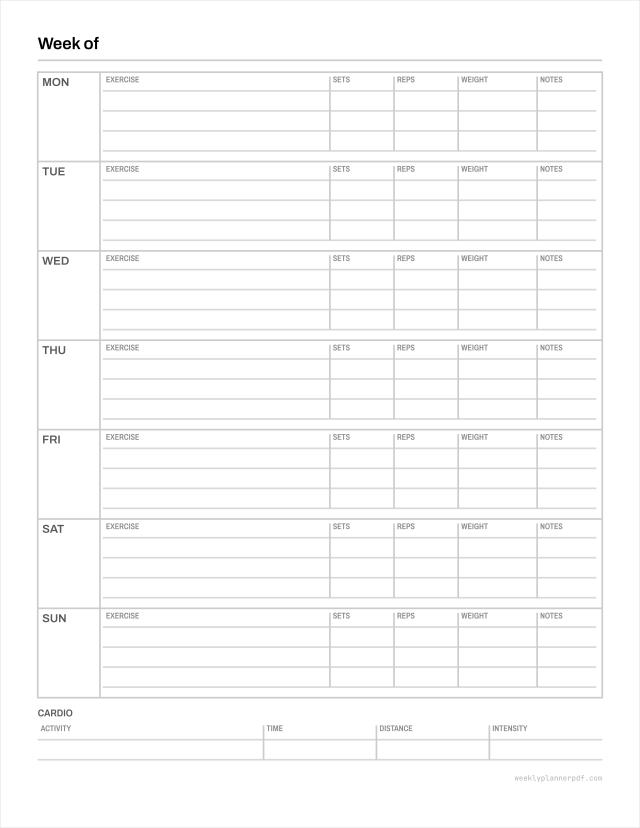
Weekly workout schedule
Exercise, sets, reps and weight as four columns, with cardio on its own strip. Most printable workout charts track two of those three numbers, which makes progression impossible to see.
No signup. No email. No watermark. No limits.
- Page box
- 215.9 x 279.4 mm 612 x 792 pt
- Margins
- 12.7 mm all sides
- Writing rows
- 7.5 mm
- Colour
- DeviceGray, rules at 20% K
- Scaling
- Prints at 100%, Actual size preset
Other versions: Sunday start, 2-up and trim-mark sheets
Sets, reps AND weight
Progressive overload, which is the entire mechanism by which strength training works, requires knowing all three. Sets and reps alone tell you the volume but not the load; weight alone tells you the load but not how much of it you did. Most printable workout charts track two of the three and are therefore useless for the thing they exist to support.
Four columns per exercise: name, sets, reps, weight, plus a notes column for how it felt. That is enough to decide next week's numbers without remembering anything.
Cardio is a different schema
Cardio does not have sets and reps. It has duration, distance and intensity, which is a different set of columns, so it gets its own strip at the bottom rather than being forced into the strength table.
Trying to log a 5 km run in a sets-and-reps grid is why most combined charts get abandoned.
Rest days
Leave them blank and mark them. A rest day that is written down is part of the programme; a rest day that is just an empty row looks like a missed session, and after two weeks of that most people quietly stop filling the sheet in.
Also known as
This layout is searched for under several names, and they all describe the same file: weekly workout planner printable, workout log printable, weekly fitness planner printable. One page, one grid.
Related
- Workout log printable
A single-day log with more exercise rows
- Weekly habit tracker
If you want consistency rather than numbers