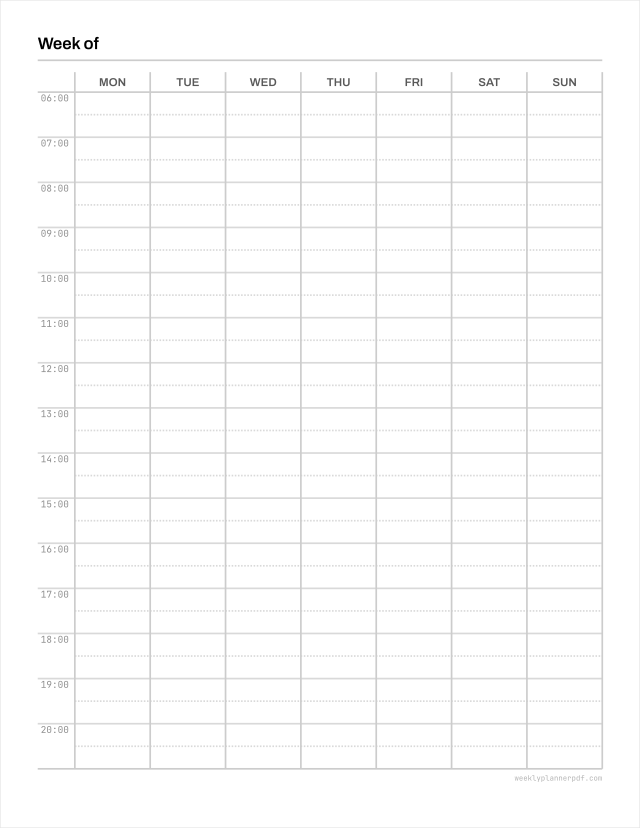
Hourly weekly planner
Seven day columns against an hour rail, so you can see where the week actually goes. Half-hour rows at 8.6mm, which is above the handwriting comfort line rather than at the floor.
No signup. No email. No watermark. No limits.
- Page box
- 215.9 x 279.4 mm 612 x 792 pt
- Margins
- 12.7 mm all sides
- Writing rows
- 7.5 mm
- Hours
- 06:00 to 21:00, 30 min rows
- Colour
- DeviceGray, rules at 20% K
- Scaling
- Prints at 100%, Actual size preset
Other versions: Sunday start, 2-up and trim-mark sheets
Who this layout is for
An hourly grid suits anyone whose week is made of appointments rather than tasks. Therapists and tutors billing by the session, shift workers reconciling a rota, students fitting study around fixed classes, and anyone who keeps overcommitting because a to-do list has no sense of how long a day actually is.
If your week is mostly a list of things to get done and not a series of times, the horizontal or vertical layouts give you more writing room for the same paper. The hour rail costs about 21mm of width, which is real when the sheet is small.
Why the rows are the size they are
Comfortable adult handwriting needs about 7mm of line height. College-ruled paper is 7.1mm, narrow-ruled is 6.35mm, and the planner community consistently rejects anything below 6mm as unusable. Our half-hour rows come out around 8.6mm on Letter and A4, above the comfort line rather than sitting on the floor.
That matters more than it sounds. Erin Condren, whose vertical layout the whole industry copies, ships its hourly planner with 0.25 inch half-hour rows. That is 6.35mm, which is exactly the narrow-ruled minimum. It is the reason hourly planners get called cramped, and it is a standard worth beating rather than matching.
The grid is drawn solid on the hour and dashed on the half hour, and there are no closed cell borders inside a day. That is the time-blocking convention: blocks are drawn by hand across several slots, and a boxed cell fights the pen.
Choosing an hour range
The default is 6am to 9pm, which is fifteen hours and the range most commercial hourly planners ship. Passion Planner runs to 10:30pm; Erin Condren covers 6am to 7pm. Nobody covers twenty-four hours, because at a legible row height a full day does not fit on one sheet.
You can set any start and end hour in the generator, and the engine will hold the row height above the legibility floor rather than squeezing. If the range you ask for will not fit at 30-minute rows it moves to 60-minute rows and tells you, rather than quietly shrinking the grid.
Printing it
Print at 100% or Actual size, never Fit to page. The file already sets the print dialog to Actual size for you, which is a one-line setting almost nobody in this category uses and the single most common reason a planner comes out the wrong size.
Every file has 12.7mm margins on all four sides. That is the smallest single value that clears every printer specification we could find, including the HP models that reserve 12mm at the bottom on macOS and the Epson models that reserve 15mm on cut-sheet media.
Also known as
This layout is searched for under several names, and they all describe the same file: weekly planner with time slots, weekly planner with hours, printable weekly calendar with time slots, printable weekly schedule by hour, weekly hourly schedule template. One page, one grid.
Questions
Is this the same as a weekly planner with time slots?
Yes. Hourly weekly planner, weekly planner with time slots, weekly planner with hours and weekly schedule by hour all describe this grid. One page, one file, all the same thing.
Can I get 15 minute increments?
Yes, on the 15 minute page. Fifteen-minute rows need more vertical run than 30-minute rows, so that version covers a shorter span of the day on the same sheet or needs a larger sheet.
Does it work on A5?
Not with seven day columns in portrait. Seven columns on A5 leaves 16mm per day, which is about three handwritten characters. A5 works in landscape, or as a two-page spread, which is what ring-binder planners have always done.
Related
- 15 minute
Need finer slots for session billing
- Weekly time blocking template
Same grid plus a capture column, for time blocking
- Horizontal weekly planner
More writing room if your week is tasks rather than times
- Class schedule template
A five-day version for a recurring timetable